



July 28, 2026 – What happens in Europe’s cafés and restaurants increasingly signals what lands on retail shelves next. Foodservice trends are increasingly a leading indicator for product development, revealing distinct regional habits and clear gaps brands can fill. Some markets pursue novelty and experience, others adopt trends quickly once they appear in neighboring markets, and others remain selective and slower to adopt. For brands aiming at younger consumers, the space between what’s popular in cafés and what’s actually available in stores, especially in specialty coffee, tea, and global flavors, is where the growth sits. Innova’s Foodservice as Europe’s Leading Retail Signal report maps these shifts across Europe’s major markets.
How Differently do European Markets Adopt New Trends?
Each major European market takes a distinct approach to foodservice and new trends. Spain is a high-frequency, novelty-driven market, with 42% of consumers regularly visiting cafés and a strong majority drawn to novelty and seasonal offerings. The UK is experience-led and convenience-focused, with two in three consumers prioritizing the overall experience and an international palate that makes them highly open to global flavors. Germany is a fast-follower market. Once a trend gains traction in neighboring countries, it is adopted quickly, as demonstrated by the rapid rise of matcha. France sits at the other end, more restrained and quality-focused, slower and more selective in what it adopts.
Why is Specialty Coffee Jumping from Café to Shelf?
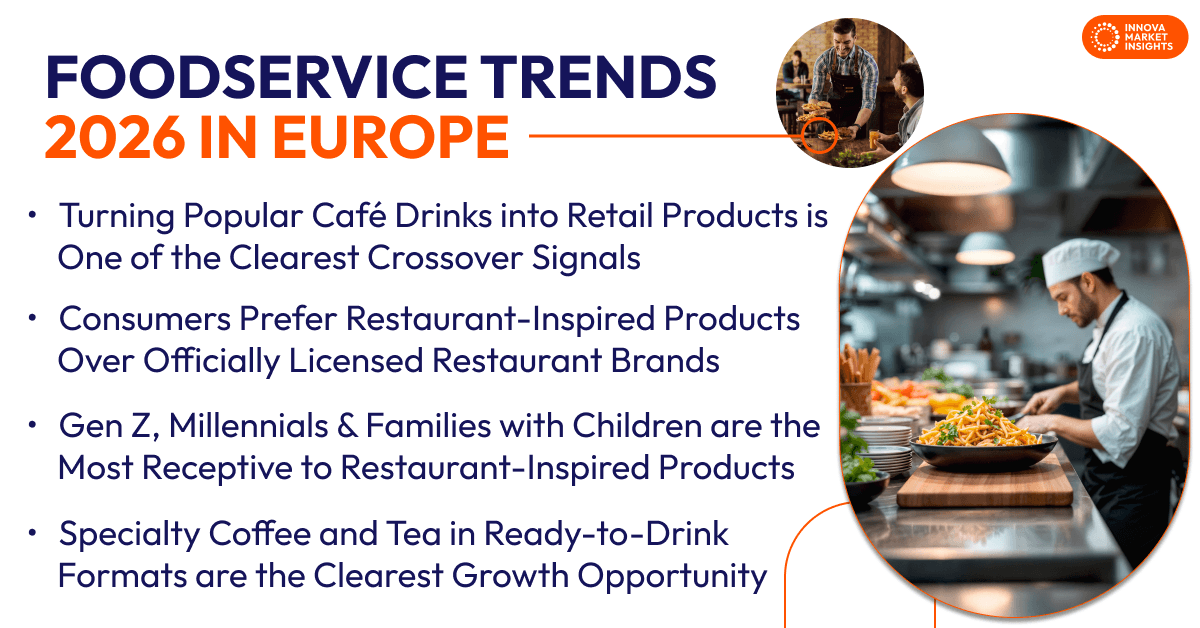
Turning popular café drinks into retail products is one of the clearest crossover signals, and specialty coffee is leading the way. Across the EU, retail launches of iced and ready-to-drink coffee grew by more than half between 2023 and 2025. Germany drove the surge, roughly doubling its iced and RTD coffee launches to become the fastest-growing market, with the UK close behind on strong expansion and Spain growing more modestly. France was the outlier, with launches in the category slipping backward. The same pattern shows up in iced and RTD tea, where EU retail launches grew sharply over the same period.
Which Flavors are Scaling Fastest?
Several flavors are making the jump from restaurant menus to retail shelves, and pistachio is out in front. Pistachio-themed retail launches more than doubled across Europe between 2023 and 2025, with the UK driving the trend hardest, followed by Germany, Spain, and France. Matcha is scaling sharply too, especially in Germany thanks to its fast cross-border adoption, while the UK keeps innovating with unique matcha formats. Korean-inspired flavors are rising fast and represent a real untapped opening for retail brands outside the UK, and emerging profiles like yuzu, masala, and cookie butter are drawing attention. That being said, how far they can travel across categories at scale is under assessment.
Who is Buying These Restaurant-Inspired Products?
There’s clear demand for bringing the restaurant experience home, and consumers consistently prefer restaurant-inspired products over officially licensed restaurant brands across every major European market. The UK leads the appetite, with 28% of consumers interested in restaurant-inspired products, ahead of licensed brands at a lower share. Germany and Spain follow at similar levels, and France, while lowest, still shows notable interest. Across all these markets, the most receptive consumers are the same. These are Gen Z, Millennials, and families with children.
What’s Next for Restaurant-To-Retail Crossover?
This crossover from foodservice to retail is set to grow. Specialty coffee and tea in ready-to-drink formats are the clearest growth engine, and the markets that have lagged, everywhere outside Germany and the UK, are where opportunity now sits. In flavors, pistachio’s momentum shows how fast a foodservice favorite can scale in retail, and Korean-inspired profiles are the standout white space beyond the UK. The common thread is generational: brands that translate café and restaurant experiences into retail products aimed at Gen Z, Millennials, and young families are best placed to capture the crossover. The opening lies in closing the gap between what’s popular in cafés and what consumers can actually buy in store.
This article is based on Innova’s Foodservice as Europe’s Leading Retail Signal report. This report is available to purchase or with an Innova Reports subscription. Reach out to learn more.